
Andaism
The complete reference text · 24 min read
Andaism is a modern religious and philosophical tradition centered on Mengü, the Endless Sky. Mengü is understood not as a personal deity, but as an all-present sacred reality: the infinity of nature, thought, life, death, community, and the unknown beyond human understanding.
The tradition is built around Ands, an oath-based system derived from the word and, meaning oath or vow. In Andaism, faith is expressed less through fixed dogma and more through repeated vows: to live with honor, keep one's eyes on Mengü, accept uncertainty, respect nature, protect the vulnerable, and continue returning to the good.
A distinctive feature of Andaism is its acceptance of religious uncertainty. It teaches that no human being can fully know the final truth about God, death, existence, or the meaning of life. This gives Andaism an agnostic character: the Anda does not swear because certainty has been reached, but because belief, oath, and ritual offer a way to live with meaning and inner peace beneath the unknown.
Followers of Andaism are called Andas. Its spiritual leaders are called Onba, and its prayer houses are called Gökevi, meaning "Sky House."
1Overview
Andaism combines religion, life philosophy, oath tradition, nature reverence, music, communal ritual, science-friendly thought, and existential reflection. It begins with the admission that human beings do not know the final truth, but still need meaning, direction, peace, and belonging.
Its central response to uncertainty is not withdrawal, despair, or rigid certainty. It is oath and life.
Let's be alive!
This phrase expresses one of the main attitudes of Andaism: since life remains mysterious, the proper response is to live with dignity, openness, courage, and connection.
Andaism does not teach that a person must become flawless. An Anda may break an oath, fail a principle, or lose direction. What matters is whether the Anda returns to Ands. Since no one is perfect, return is central to the tradition.
2Etymology and terminology
The key terms of Andaism are:
Mengü: the Endless Sky; the sacred infinity in and around existence.
And: a single oath or vow.
Ands: the oath-based system of Andaism, and also the body of official texts, vows, prayers, and teachings.
Anda: a follower of Andaism.
Onba: a spiritual leader, guide, or priestly figure.
Gökevi: a prayer house or Sky House.
Esen: a greeting or blessing of peace, wellness, and goodwill.
The word and is associated with oath or vow. In Andaism, this idea becomes the foundation of religious life. A person does not merely declare belief, but swears a direction of life beneath Mengü.
3Mengü
Mengü, the Endless Sky, is the central sacred concept in Andaism. It is not simply the physical sky, but the name for endlessness itself.
Mengü includes the universe, nature, thought, memory, death, love, fear, uncertainty, time, and everything beyond human comprehension. It is above the human being, but also within the human being.
Because of this, Andaism teaches that true judgment does not come from society, shame, gossip, or public opinion. Only Mengü can judge.
This judgment is not a heavenly trial, but a measure of whether a person keeps returning to Ands. Every sincere return brings the Anda closer to Mengü and closer to becoming endless.
For Andas, Mengü is both cosmic and intimate: the vastness above the world and the quiet witness within the self.
4Ands
Ands is the central oath-based system of Andaism. It is built on the word and, meaning oath or vow.
An and is a sacred promise made beneath Mengü. Ands is the wider structure formed by these vows. Through Ands, a person gives direction to life.
Unlike religious systems that focus mainly on belief statements, Andaism focuses on sworn intention. The Anda does not only say what they believe. The Anda swears how they intend to live.
Ands is not a strict legal code. It is a structure of return. When an Anda breaks an oath, the goal is not permanent guilt, but recognition, repair, and return.
To return to Ands after failure is one of the most important acts in Andaism. The tradition teaches that no one is perfect, and that the direction of a life matters more than a single fall.
5Becoming endless
A central aim of Andaism is becoming endless. This is one of the core teachings of the tradition and one of the main purposes of following Ands.
In Andaism, becoming endless does not mean becoming physically immortal, becoming flawless, or becoming greater than other people. It is not a promise that the Anda will escape death, become divine, or reach a perfect state beyond ordinary life. Instead, becoming endless means growing closer to Mengü by widening the self beyond fear, shame, ego, isolation, and false certainty.
For Andas, life is the only thing human beings truly know. Other lives, realms, worlds, or states of existence may exist, but Andaism teaches that no person can know this with certainty. Because of this, the focus of Andaism is not escape from this life, but fuller presence within it. The Anda is called to live here, now, beneath Mengü.
This gives becoming endless a practical meaning. It is not only a teaching about death or eternity. It is also a way of living with less fear in daily life. Human beings often suffer under the weight of failure, shame, judgment, uncertainty, regret, and fear of existence itself. Andaism teaches that these burdens cannot always be solved by perfect answers. Instead, they are softened by returning to Ands.
To become endless is to loosen the grip of these fears. It is to understand that one bad day does not define a life, that failure is part of the path, that uncertainty is not an enemy, and that the opinions of others are not the final measure of the self. The Anda does not become endless by escaping human weakness, but by learning to live peacefully with it.
Ands is the path toward this endlessness. Every oath gives direction. Every prayer is a return. Every sincere attempt to stand upright, protect the vulnerable, respect nature, accept uncertainty, repair harm, and live with an open heart brings the Anda closer to Mengü.
Becoming endless is therefore both spiritual and psychological. Spiritually, it means becoming closer to Mengü and more united with nature, thought, community, the world, and existence. Psychologically, it means becoming less trapped by stress, shame, fear, and the need for absolute certainty. The Anda learns to breathe inside the unknown.
In Andaism, becoming endless can begin during life. It is experienced in moments of peace, courage, music, nature, prayer, forgiveness, hospitality, and deep connection. It may be felt when a person stops fighting their own uncertainty, apologizes after failure, protects someone weaker, stands upright after fear, or sits beneath the sky and feels part of something wider than themselves.
After death, Andaism teaches that the person returns to Mengü. The separate self dissolves into the Endless Sky. But because the future beyond death cannot be known with certainty, Andaism does not ask the Anda to live only for another world. It asks them to live this life fully, honestly, and peacefully.
To become endless is not to leave life behind. It is to live so deeply that the self becomes wider than its fear.
6Uncertainty
Uncertainty is one of the defining elements of Andaism.
Andaism teaches that no human being can prove with absolute certainty why existence exists, what happens after death, whether God exists, or whether Andaism itself is true. Even Mengü may be an imperfect human name for something that cannot be fully known.
This uncertainty is not treated as a weakness. It is part of the tradition and part of the oath.
The Anda does not swear because all doubt has disappeared. The Anda swears while accepting doubt, choosing belief as a meaningful path beneath the unknown.
This gives Andaism an agnostic tint. Belief is not presented as possession of final knowledge, but as a chosen orientation: a way to give meaning to the world, find inner peace, and live responsibly.
Andaism therefore differs from traditions that depend strongly on exclusive claims of final certainty. It allows belief and doubt to exist together. An Anda may believe deeply while still admitting that the final truth is unknown.
7Texts
The official texts of Andaism are called Ands. The term therefore refers both to the oath-based system and to the living body of sacred or official texts used in study, prayer, and ritual.
The most important text is the main And, the central oath of Andaism. Alongside the main And, additional ands may be written, added, studied, and used during prayer sessions, reading, reflection, and gatherings in the Gökevi.
This makes Andaism a living textual tradition. Its texts are honored, but not treated as prisons. Because uncertainty is part of the tradition, Ands can continue to grow, provided that new texts remain consistent with the core principles of Mengü, return, openness, nature, sincerity, and becoming endless.
8The main And
The main personal oath of Andaism is called the And.
A common English form of the And is:
I swear that I will be a nomad, my heart open to everyone.
I swear that I will live with my eyes fixed on the Endless Sky, shoulders straight, honorably, with a healthy body and a clear mind.
I swear that I will become one with Infinity.
I swear that I will learn to live with uncertainty.
I swear that I will have reverence for nature and that I will leave the world greener.
I swear that I will not hide my wrinkles and cracks, because this does not make me less, but only more.
I swear it.
I swear.
I swear it.
The And may be spoken privately, before an Onba, inside a Gökevi, or during a community ceremony. Its authority comes from sincerity rather than external enforcement.
9Becoming Anda
A person becomes an Anda by saying the main And and afterward going to a Gökevi.
An Onba is not required for this act. The oath is a pact with oneself beneath Mengü, and therefore no spiritual leader needs to stand beside the person for the oath to be valid.
This reflects a core belief of Andaism: meaning cannot be forced into a person from outside. It must be encountered within the self. The community can witness, welcome, and support, but the oath itself belongs to the person who speaks it.
People may also attend Gökevi gatherings, study Ands, speak with Andas or Onba, and participate in communal life before formally taking the And.
10Daily practice
Andas are encouraged to return to Ands daily.
A common rhythm of practice is:
- in the morning after waking;
- at night before sleeping;
- preferably once in the afternoon as well.
These moments may include prayer, recitation of an and, reflection on the Six Pillars, silence, music, or a simple act of recommitment. The purpose is not to perform perfection, but to return to direction.
Daily practice helps the Anda remember Mengü, recognize uncertainty, loosen fear, and continue striving toward becoming endless.
11The Six Pillars of Ands
The ethical and spiritual life of Andaism is structured around six pillars. These are not commandments in a strict legal sense, but directions to which an Anda repeatedly returns.
The Six Pillars are:
Together, they describe the path of an Anda: openness, dignity, humility, nature, responsibility, and continuing intention.
11.1Nomadism
Nomadism is the first pillar of Ands.
In Andaism, nomadism does not only mean physical wandering. It refers to an open heart and a moving mind. A nomad remains open to different cultures, people, countries, customs, ideas, and paths.
Nomadism also teaches simplicity. A nomad can live from a piece of bread, but can also enjoy a full table. The nomadic heart can belong to more than one place without losing itself.
For Andas, nomadism is the refusal to become spiritually trapped. When the heart grows too small for its surroundings, a new path must be carved.
11.2A Straight Back
A Straight Back is the second pillar of Ands.
It represents honor, courage, honesty, discipline, physical health, and mental strength. It is often summarized through the image:
Shoulders straight.
Chest forward.
Eyes on Mengü.
A Straight Back does not mean arrogance or emotional hardness. It means dignity. It means standing upright even when afraid, ashamed, uncertain, or wounded.
Strength, in Andaism, includes the willingness to protect weakness, including weakness within oneself.
11.3Infinity
Infinity is the third pillar of Ands.
Infinity teaches that reality is larger than one person, one nation, one religion, one planet, or one idea. Earth is not the only world, and human truth does not end with one tradition.
Because of this, Andaism teaches that people may approach the Endless Sky in many ways: through belief in one God, many gods, philosophy, science, music, nature, art, silence, meditation, or even disbelief.
The Anda is not superior to others, but also not inferior. Every person lives beneath the same Endless Sky.
11.4Reverence for Nature
Reverence for Nature is the fifth pillar of Ands.
Andaism teaches that the human being is part of nature and that nature is part of the human being. Trees, soil, animals, wind, water, stone, seasons, and silence are not merely scenery. They are mirrors through which the human being can come to know the self.
Touching a tree and closing one's eyes can be a simple spiritual act. Walking in nature is often preferred in silence or solitude, allowing the Anda to feel Mengü more clearly.
Nature is not romanticized as a cure for all suffering. It can comfort, but it can also confront. Yet it remains kin to the human being.
This pillar contains an ecological duty:
Leave the world greener than you found it.
11.5Intention as Thread
Intention as Thread is the sixth pillar of Ands.
This pillar teaches that no human being lives without cracks. People have wounds, bad days, shame, anger, failure, temptation, confusion, and relapse. Andaism does not treat these as proof that a person is worthless.
Perfection is not faultlessness. Perfection is the intention that continues.
Intention is the thread that runs through one's cracks and brings one back toward the good. A person is not defined by a single fall, but by the direction in which they continue to rise.
The crack is not shame. The crack is history.
12Prayer
Prayer in Andaism is closely connected to Ands. Many prayers are structured not primarily as requests to Mengü, but as repeated vows spoken beneath Mengü.
The Anda does not only pray for help. The Anda swears to live differently.
This makes Andaist prayer active rather than passive. It is a ritual of alignment: the speaker places the self before Mengü and repeats the direction in which they intend to live.
Andas pray in their own language. There is no single mandatory sacred language in Andaism. Prayer may be spoken in Turkish, English, Dutch, or any other language. Meaning, presence, and intention are considered more important than language itself.
13The Prayer to Mengü
A central prayer of Andaism was originally formulated in Turkish. It includes a greeting to Mengü, a series of oaths, a bowing moment in which fear is spoken, and a standing affirmation of honesty, protection, unity, and life.
13.1Turkish
Hoş geldin Mengü.
Gözlerimi sonsuz gökyüzünden ayırmayacağıma and içerim.
Dik duracağıma, and içerim.
Duru bir usla, sağlıklı yaşayacağıma, and içerim.
Göçebe gibi yüreğimi bütün evrene açacağıma, and içerim.
Düşünce başkasının değil, düşünce ben olduğunu, and içerim.
Eğiliyoruz.
Korkularını söyle....
Sonra dik durarak:
Dik duracağız.
Dürüst olacağız.
Güçsüz olanları, özümüz dahil, koruyacağız.
Haydi sonsuz olalım, Andalar!
Haydi bir olalım, Andalar!
Haydi yaşayalım, Andalar!
13.2English
Welcome, Mengü.
I swear that I will not take my eyes away from the Endless Sky.
I swear that I will stand upright.
I swear that I will live with a clear mind and a healthy body.
I swear that, like a nomad, I will open my heart to the whole universe.
I swear that thought does not belong to another; thought is myself.We bow.
Speak your fears.Then, standing upright:
We will stand upright.
We will be honest.
We will protect the weak, including the weakness within ourselves.Let's become endless, Anda's!
Let's become one, Anda's!
Let's be alive, Anda's!
14Ritual movement
The Prayer to Mengü contains two central bodily movements: bowing and standing.
The bowing moment is not an act of humiliation. It is an act of honesty. The Anda bows to acknowledge fear, uncertainty, pain, shame, or weakness. In some ceremonies, participants may speak their fears aloud or silently.
The second movement is standing upright. After fear has been acknowledged, the Anda rises. The person does not stand because fear has disappeared, but because fear has been recognized.
This movement expresses one of the central patterns of Andaism:
Recognize what is within you.
Then stand.
15Gökevi
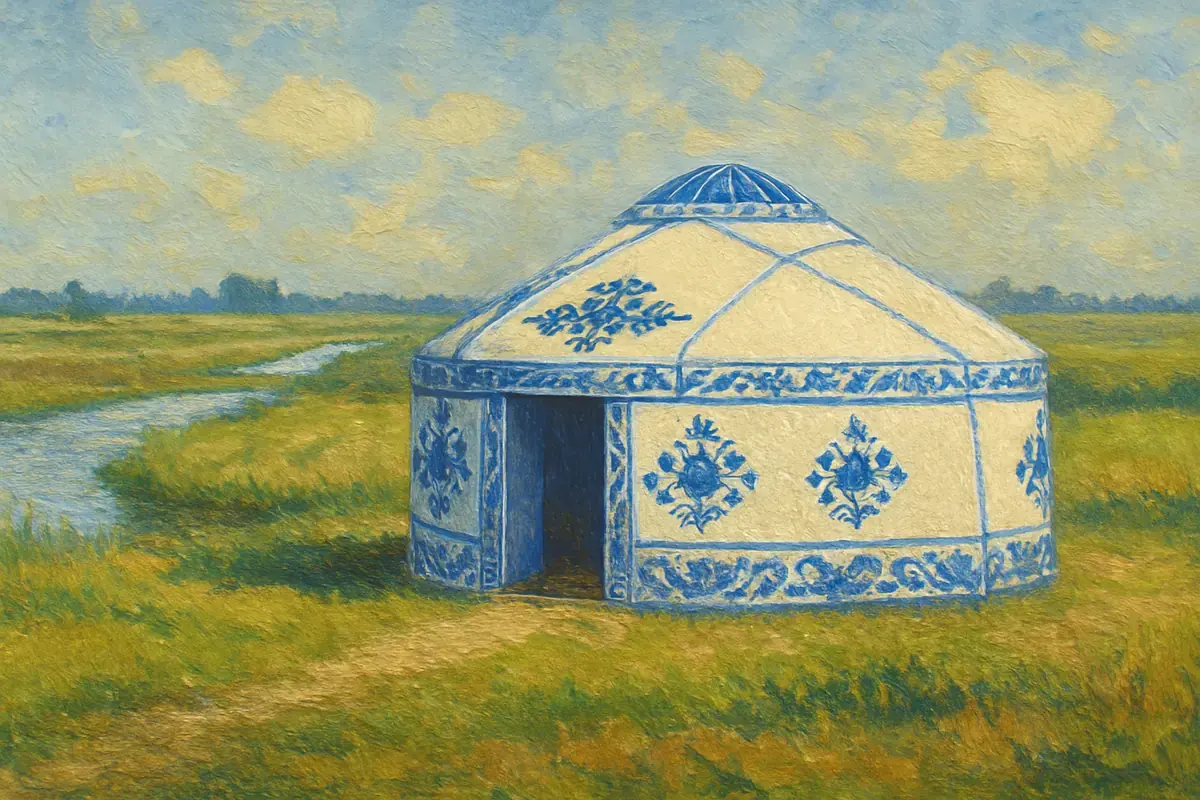
The prayer house of Andaism is called a Gökevi, meaning "Sky House."
A Gökevi is usually imagined as a warm, communal, yurt-like space. The floor is carpeted, and visitors remove their shoes before entering. The atmosphere is peaceful, hospitable, and intimate.
A Gökevi is used for prayer, music, discussion, eating, drinking, study, reconciliation, and community life. It is not only a sacred building, but a house of belonging.
Gökevi are open not only to Andas, but also to guests, seekers, people of other religions, and nonbelievers.
16Friday ceremony
Friday is the sacred communal day of Andaism. Andas gather at the Gökevi for prayer, music, reflection, study, and hospitality.
A ceremony may include greeting with Esen, silence or soft music, the Prayer to Mengü, the bowing moment, the speaking of fears, standing upright, collective affirmation, singing or instrumental music, recitation of the And, and food or drink afterward.
The social gathering after the ceremony is not considered separate from the religious act. Hospitality is itself sacred in Andaism.
17Music
Music plays a central role in Andaism.
Andaist music is inspired by instruments such as the bağlama and kopuz. Peaceful forms of throat singing may also appear. Unlike martial or aggressive forms of throat singing, Andaist vocal expression is meditative, earthy, and communal.
Music is considered a path toward unity. Through rhythm, voice, and shared breath, the Anda may become more deeply connected with the community, nature, thought, and Mengü.
18Onba
The spiritual leaders of Andaism are called Onba.
An Onba is expected to be spiritually serious, honorable, helpful, and active within the community. An Onba may teach, guide prayer, support families, mediate conflicts, preserve texts, advise the community, and help people return to Ands after failure or hardship.
An Onba does not possess the authority to condemn a soul. Only Mengü can truly judge. The role of the Onba is therefore guidance, not domination.
19Ranks of Onba
Onba may be organized into levels of responsibility. The exact titles may vary, but the structure is based on service, trust, and spiritual maturity rather than domination.
A possible structure is:
- First Onba: a recognized spiritual servant who assists in prayer, study, and community care.
- High Onba: a trusted leader with greater responsibility in teaching, ceremony, and guidance.
- Elder Onba: a senior spiritual leader recognized for long service, wisdom, and deep trust.
Higher rank is not understood as personal superiority. It is a heavier form of service.
20Safeguarding and misconduct
Andaism rejects cult behavior, coercion, corruption, and abuse of spiritual power.
Onba and other community figures are expected to serve rather than dominate. They may not use spiritual authority for sexual access, manipulation, financial exploitation, or control over another person's life.
Such behavior is considered a severe violation of Andaism and should be reported immediately to civil authorities. In Andaism, spiritual leadership is not above the law.
21Ethics
Andaism does not contain a doctrine of sin in the same way found in some other religions. Wrongdoing is not understood as a permanent spiritual stain or a debt to be weighed in a divine courtroom.
However, Andaism does not deny good and evil. Acts such as murder, cruelty, betrayal, humiliation, and abuse are considered deeply wrong. Andaism teaches that every human being with a natural understanding of life already carries some awareness of right and wrong.
The difference is that Andaism treats moral life as a process. Human beings have good days and bad days. They act from pain, fear, anger, confusion, desire, or weakness. These failures do not make a person worthless.
What matters is intention over time. If a person sincerely intends to become better, recognizes harm, apologizes when needed, repairs what can be repaired, and returns to the good, then the thread of intention remains.
22Passion and temperament
Andaism recognizes passion, temperament, intensity, and fire as part of being alive.
A person may be intense, expressive, emotional, and driven. Passion is not treated as wrong in itself. It is a sign of life moving through the human being.
If passion causes harm, the Anda must recognize this, reflect, apologize, and repair. But temperament itself is not condemned. It belongs to the process of being human beneath Mengü.
23Hospitality and other religions
Hospitality is one of the central virtues of Andaism.
Gökevi are open not only to Andas, but also to people of other religions and to nonbelievers. Because Andaism accepts uncertainty, it does not claim that all other religions must be false.
Andas may speak with Christians, Muslims, Jews, Hindus, Buddhists, Tengriists, atheists, agnostics, and others. They may meditate or pray in the houses of other religions, provided they do so respectfully.
This openness comes from the belief that all people are children of the sky.
24Science, technology, and AI
Andaism strongly encourages science, learning, and contribution to knowledge. Andas are taught to respect evidence-based knowledge and to choose science when scientific findings conflict with religious wording or interpretation.
A common principle in Andaism is that if the words of Andaism are not in accordance with science, science should be chosen. This reflects the tradition's acceptance of uncertainty and its belief that truth should not be feared.
Andaism also engages with modern technology, including artificial intelligence. It recognizes that AI may replace or transform many human roles in the future. Rather than responding only with fear, Andas are encouraged to focus on coexistence, adaptation, ethics, and preserving human meaning.
In this view, human worth should not depend only on productivity, employment, or economic usefulness. If machines change the role of human labor, Andas are encouraged to seek meaning through community, nature, creativity, care, learning, and spiritual life.
25Knowledge and study
Andaism values study and intellectual openness.
Truth is not understood as something fully captured forever by human words. New discoveries may change old beliefs. Because uncertainty is one of the pillars, Andaism encourages learning, revision, and honest discussion.
Texts and oaths are honored, but they are not prisons. Ands may grow, and Andas are encouraged to read, study, discuss, and refine their understanding.
26Mental health and meaning
Andaism emerged partly from experiences of anxiety, loneliness, lostness, and lack of meaning. It offers ritual, language, community, and direction for people who feel uncertain or spiritually homeless.
However, Andaism is not presented as a substitute for medical or psychological care. It may provide meaning, belonging, and practices of reflection, but serious mental health issues should be addressed with appropriate professional support.
The tradition's contribution is existential rather than clinical: it gives people a way to live with uncertainty, failure, loneliness, and fear without pretending that all suffering can be solved by simple answers.
27Death and return to Mengü
Andaism teaches that when a person dies, he or she returns to Mengü, the Endless Sky.
Andas do not generally believe in an afterlife of heaven and hell in which the soul is judged by a personal divine ruler. They also do not believe in reincarnation or a cycle of rebirth that must be escaped.
This return is often described as emptiness. In Andaism, emptiness does not mean punishment, destruction, or meaninglessness. It means peaceful unity with eternity. The separate ego dissolves into the endless whole.
The stronger a person's bond with Mengü, thought, nature, community, the world, and their surroundings, the more deeply that person becomes one with eternity.
Death is not a courtroom. It is not a reward or punishment system. It is return.
Because the future beyond death cannot be known with certainty, Andaism focuses strongly on this life. The Anda is called to live fully here and now, while remaining open to the mystery of what may come after.
28Relationship to other traditions
Andaism shares themes with older religions and philosophies, but does not fully belong to any of them.
It resembles Tengrism in its reverence for the sky, steppe symbolism, and connection between nature and cosmic order. It resembles Stoicism in its concern with inner discipline and uncertainty. It resembles existentialism in its concern with meaning, anxiety, and life under uncertainty. It resembles some mystical traditions in teaching that the sacred is not only outside the human being, but also within.
However, Andaism differs from many traditions through its central idea of Ands as an oath system, its explicit acceptance of uncertainty, its agnostic tint, its rejection of a punitive doctrine of sin, its positive view of passion, and its understanding of intention as more important than impossible perfection.
29Cultural background and influences
Andaism developed from a background between Dutch and Turkish culture. Because of this, it carries both Eastern and Western influences. It can be understood as a melting pot shaped by steppe imagery, modern European life, Turkic ancestry, existential thought, science, technology, music, and fantasy literature.
Important influences include Turkic and steppe symbolism, the concept of oath and sworn brotherhood, sky-centered spirituality, Tengrism-like reverence for the sky and nature, Stoic ideas of discipline and inner strength, agnostic and existential thought, nature reverence, fantasy worldbuilding and mythic imagination, modern science and technology, and Anatolian and Turkic musical atmosphere.
Andaism does not present these influences as direct ownership or simple continuation. Instead, it reworks them into a modern tradition centered on Mengü, Ands, uncertainty, and becoming endless.
30History
Andaism was founded in 2024 in Delft, the Netherlands, by Merthan Tukuş, who was 26 years old at the time. Tukuş was born in Delft and is of Turkish ancestry. The early formation of Andaism was shaped by his experience of living between the Netherlands and Turkey, while feeling that he did not fully belong to either.
This sense of being between worlds became one of the emotional roots of Andaism. Rather than locating home entirely in one country, ethnicity, or culture, Andaism expresses the idea that one's deepest home and tribe can be found in Mengü. In this sense, Mengü becomes a spiritual homeland for people who feel divided, rootless, lonely, or without a clear place in the world.
Tukuş has described the early formation of Andaism as connected to anxiety, loneliness, lack of meaning, and the search for purpose. The tradition grew partly from the need to create a framework that could help him live with uncertainty, failure, fear, and the feeling of being lost.
Andaism therefore developed as both a personal path and a communal philosophy. It is not presented as a final truth imposed on all people, but as a way of living for those who feel its principles are meaningful enough to live by, study, practice, and perhaps one day swear to.
31Founder
Merthan Tukuş is the founder of Andaism. He is a TU Delft Computer Science and Engineering alumnus, a person of Turkish ancestry born in the Netherlands, and a fan of the fantasy genre. These elements helped shape Andaism's character as a mixture of steppe symbolism, East-West identity, modern technology, existential thought, and mythic imagination.
Tukuş built a career in information technology and founded the IT company Sensey. At the age of 28, after having made enough money through his company, he stopped his regular career to focus fully on Andaism and the Anda.
Tukuş explicitly rejects being viewed as a prophet, divine figure, messiah, guru, or final religious authority. Within Andaism, the founder is not the source of ultimate truth. Meaning is understood to be found within the individual, beneath Mengü.
His role is therefore described as supportive rather than salvific. He is not presented as someone who gives meaning to others, but as someone who offers words, rituals, structure, and support. In Andaism, people may hold one another's hands and support one another, but no person can possess another person's final meaning.
32Summary
Andaism is a modern religion and life philosophy centered on Mengü, the Endless Sky. Its central structure is Ands, an oath-based system through which the individual makes sacred promises beneath Mengü.
Its followers are called Andas, its spiritual leaders are Onba, and its prayer houses are Gökevi.
The tradition teaches that human beings are imperfect, passionate, uncertain, and unfinished. They are not called to never fail, but to return. They are not called to know everything, but to live honestly beneath uncertainty.
Andaism's central aim is becoming endless: growing closer to Mengü by living more fully, peacefully, and sincerely in the only life human beings know for certain.
Its central slogan is:
Let's be alive!
Under Mengü, the human being is called to live, learn, repair, sing, welcome, protect, plant, wander, and become endless beneath the Endless Sky.